NOAA report establishes Chinook monitoring framework

NOAA has released a draft report establishing a common monitoring and adaptive management framework for Chinook salmon recovery in Puget Sound.

The report was prepared and written by an independent coalition of scientists known as the Puget Sound Recovery Implementation Technical Team. The group is administered by the Puget Sound Partnership, and includes representatives from NOAA and the Washington Department of Fish and Wildlife, as well as consultants and tribal organizations, with additional input from the Puget Sound Institute. Continue reading

Share

Follow the water

Scientists and policymakers often refer generally to the “Puget Sound ecosystem.” Hundreds of millions of dollars go toward its protection. Scientists and sociologists study it, and there is an assumption that we know what it is.

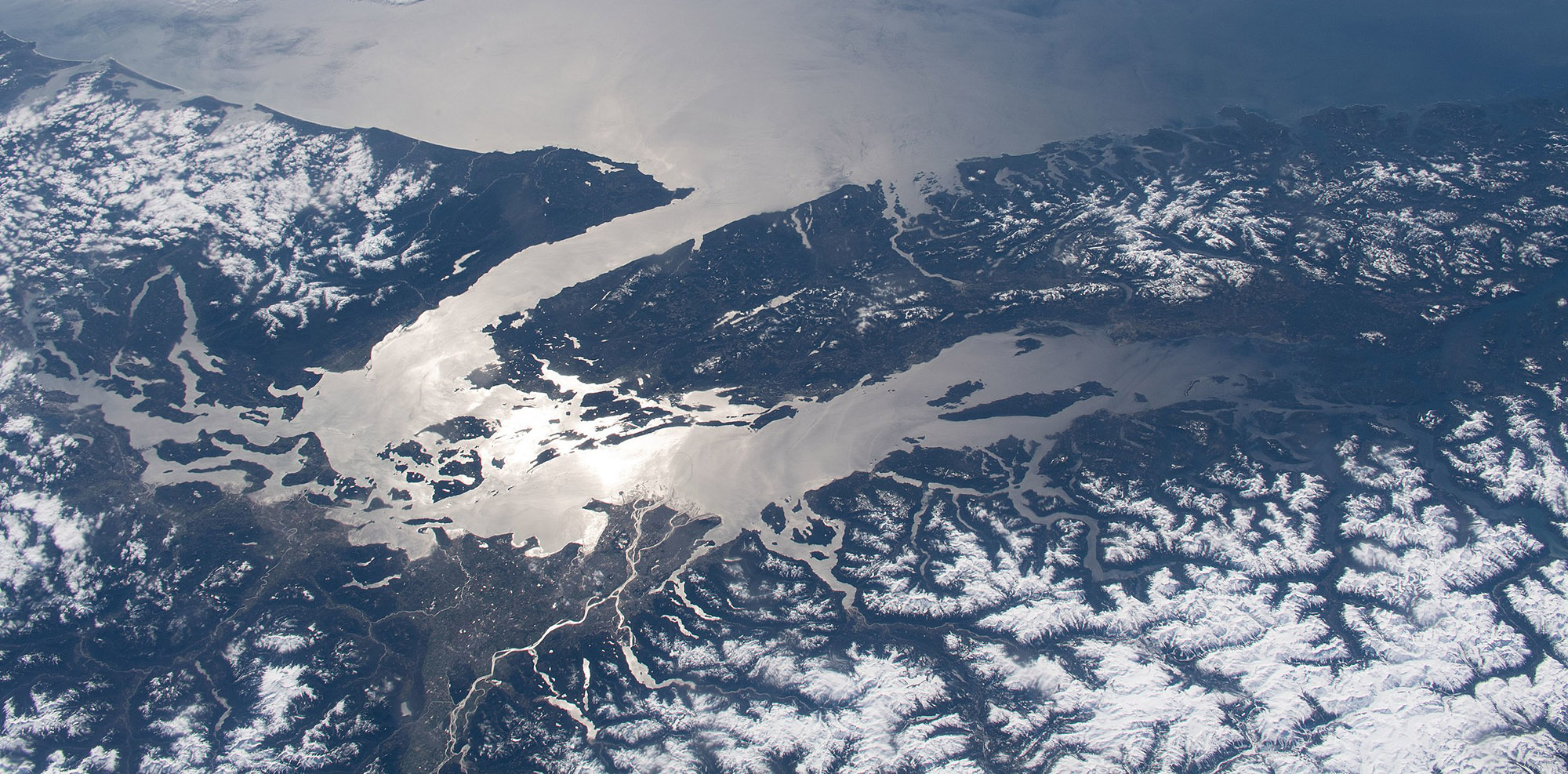
In fact, the Puget Sound region has been divided into many different geographic boundaries. There is the Puget Trough, the Salish Sea (including the waters of Canada), the Puget Sound watershed, ranging from “snowcaps to whitecaps.” Some maps don’t include the San Juan Islands or the Straight of Juan de Fuca. Some do. Some just refer to the marine environment. Other boundaries venture as far as the nearshore.

There are good reasons for all of these designations, but it makes it hard to give a straight answer to a simple question: What do you mean by “Puget Sound?”

Our answer might be “follow the water.” By Puget Sound, we typically refer to the areas that drain into and include the Puget Sound basin. These are represented by the USGS as “hydrologic units” and you can view a map and description of these boundaries on PSI’s Encyclopedia of Puget Sound here. This is also the definition used by the Puget Sound Partnership and others, with the simple idea that Puget Sound does not exist in isolation, but is fed by its many water sources, from high elevation snowmelt to wetlands and floodplains.

Follow the water. At least that sounds better than “follow the hydrologic units.”

Share

Advancing the role of science in coastal ecosystem recovery, May 14th and 15th

The Puget Sound Institute has invited representatives from six major ecosystem recovery projects for a two-day workshop, May 14th and 15th in Seattle. Participants will represent Chesepeake Bay, Everglades, Long Island Sound, San Joaquin/Sacramento Delta, Columbia River Estuary, and the Louisiana Coast. The workshop is being organized by PSI Research Scientist Nick Georgiadis, and will look at ways that science can contribute most effectively to large-scale recovery efforts, including Puget Sound. Topics include challenges relating to scope, complexity and cost in large and complex systems. Continue reading

Share

Characterizing coastal foodwebs

PSI’s  Tessa Francis is co-author of a new paper in the ICES Journal of Marine Science. The paper, “Characterizing coastal foodwebs with qualitative links to bridge the gap between the theory and the practice of ecosystem-based management” uses qualitative modeling to compare management actions in Puget Sound, Chesapeake Bay and Galveston Bay.

The authors examine loop analysis as a tool for predicting responses to press perturbations (experimental alteration of species densities). Case studies include management efforts to increase crab abundance as well as projects in Puget Sound to reduce eutrophication in relation to coastal foodwebs.

Citation: Carey, M. P., Levin, P. S., Townsend, H., Minello, T. J., Sutton, G. R., Francis, T., Harvey, C. J., Toft, J. E., Arkema, K. K., Burke, J. L., Kim, C-K., Guerry, A., Plummer, M., Spiridonov, G., and Ruckelshaus, M. Characterizing coastal foodwebs with qualitative links to bridge the gap between the theory and the practice of ecosystem-based management. – ICES Journal of Marine Science, doi:10.1093/icesjms/fst012.

Read the abstract.


Share

UW Water symposium, April 30th

The 2013 University of Washington Water Symposium is scheduled for Tuesday, April 30, 2013 at the Husky Union Building on the UW, Seattle campus. The symposium is sponsored by the Center for Urban Waters and the Puget Sound Institute and brings together scientists and engineers to present and discuss water-related research for Washington and beyond. To read more about the event, or view past proceedings, visit the Water Symposium website.


Share